


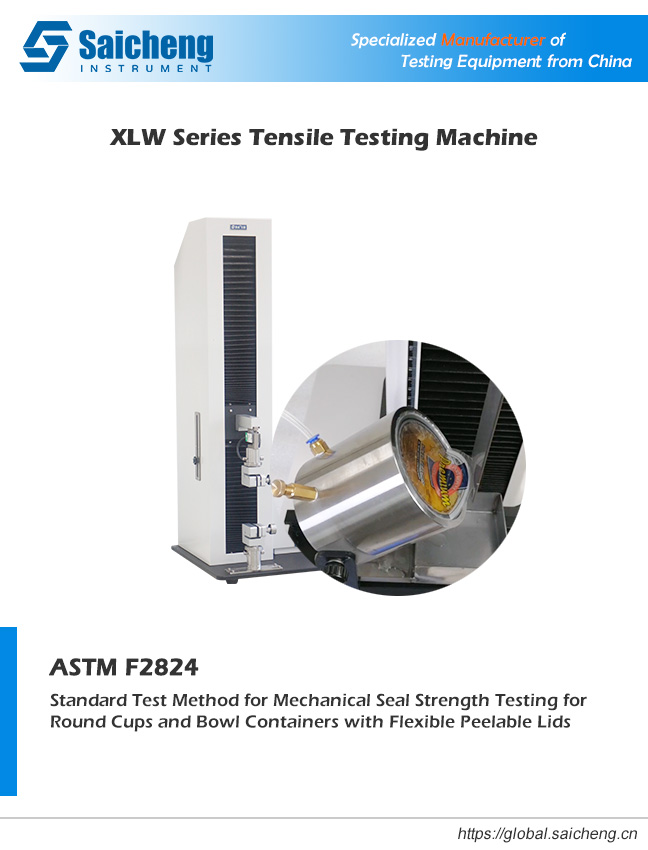
ASTM F2824
Standard Test Method for Mechanical Seal Strength Testing for Round Cups and Bowl Containers with Flexible Peelable Lids
This test method measures the strength of the mechanical seal when the entire lid (cover/membrane) is separated from a rigid or semi-rigid round container. Unlike Test Method ASTM F88, which only tests a portion of the seal, this procedure determines the continuous and maximum forces required to remove the entire lid. Although a 45° angle of pull is standard, other angles may be used if they are documented and validated. While this method is specifically intended for round containers, similar approaches can apply to various container shapes (e.g. oval, rectangular or multi-cavity designs).
When a consumer effortlessly peels open a yoghurt pot, salad container or ready-to-eat meal, it is the result of a critical engineering triumph. The perfect balance of a seal that is strong enough to protect yet gentle enough to open is no accident. It is the result of precise control and rigorous science, governed by the quantifiable ASTM F2824 standard test method. For packaging engineers, quality assurance professionals and brand managers, this standard provides the definitive protocol for measuring performance at the most critical interface: the seal between a flexible lid and a rigid container.
Understanding the Standard: What is ASTM F2824?
ASTM International, a globally recognised leader in the development of voluntary consensus standards, publishes ASTM F2824, the Standard Test Method for the Mechanical Seal Strength of Round Cups and Bowls with Flexible, Peelable Lids. This procedure provides a standardised, reproducible method of measuring the force required to initiate and propagate the peeling of a flexible lid from the flange of a round, rigid cup or bowl. The result, typically expressed in force per unit width (e.g. newtons per 15 mm or pounds per inch), provides an objective measure of seal integrity.
The core purpose of ASTM F2824 is to eliminate subjectivity. It replaces subjective assessments such as 'feels tight' with comparable, empirical data, thereby establishing a common language for suppliers, manufacturers and brands across the global supply chain.
Why Testing Seal Strength is Paramount
'Peelability' is a key aspect of user interaction. If a seal is too strong, it can cause frustration and make the product difficult to open, or even cause the product to eject upon release. Conversely, a seal that is too weak can feel insecure. ASTM F2824 provides the data needed to optimise this experience, ensuring a consistent and user-friendly opening force.
To ensure reliable results, conducting an ASTM F2824 test requires specific equipment and strict adherence to protocol.
Equipment: A universal tensile testing machine equipped with two specialised fixtures is used: a lower fixture to securely hold the cup/bowl and an upper fixture designed to engage the lip of the peelable lid without slipping (often a clamp or clip).
Sample preparation: Test specimens are conditioned in a controlled environment (standard temperature and humidity) prior to testing, as material properties can be sensitive to ambient conditions.

Medical Packaging Tester MED-02
MED-02 Medical Packaging Tester is professionally applicable to the determination of force properties of various pharmaceutical packaging materials.

Intelligent Tensile Testing Machine XLW-L
XLW-L Intelligent Tensile Testing Machine specializes in testing the mechanical properties of various flexible packaging materials.

Universal Tensile Testing Machine XLW-H
XLW-H Universal Tensile Testing Machine measures mechanical properties (tensile strength, peel, elongation rate, etc) of various flexible packaging materials.
We hope this helps and as always, we aim to ensure we can help and be proactive.
You can contact your Saicheng sales representative by email. Alternatively, complete the contact us form and we will get back to you as soon as possible.
About ASTM Standards
Learn more about the ASTM F2824 Test Standards.
Customized Testing Solutions
Meet ASTM F2824 for Your Need

About Saicheng Instrument
Saicheng Instrument Company is a technology-based enterprise dedicated to the development, production and sales of physical property testing instruments. Since its establishment in 2007, the company has provided high-quality testing instruments and comprehensive quality control solutions for packaging, food, pharmaceutical, medical equipment, adhesive products, quality inspection institutions, scientific research institutions, daily chemical industries and other industries.
-
![Saicheng - Office Building]()
Office Building -
![Saicheng - Office Wall]()
Office Wall -
![Saicheng - Laboratory]()
Laboratory -
![Saicheng - Manufacturing Workshop]()
Manufacturing Workshop -
![Saicheng - Manufacturing Workshop]()
Manufacturing Workshop -
![Saicheng - Warehouse]()
Warehouse -
![Saicheng - Visit Us at Exhibition]()
Visit Us at Exhibition -
![Saicheng - Visit Us at Exhibition]()
Visit Us at Exhibition


Why Choose Saicheng Instrument?
Jinan Saicheng Instrument adheres to independent research and development, continuous innovation, and focuses on R&D investment. The company is equipped with a high-quality, high-level R&D team. It holds complete independent intellectual property rights and is currently leading or participating in the drafting of national standards. The company has over 50 patents, including invention patents, utility model patents, and software copyrights. It has passed the evaluation for high-tech enterprises, provincial specialties, and new enterprises. Additionally, the company has obtained software enterprise and software product certifications, as well as ISO 9001 quality management system certification.
-
![Saicheng - High-tech Enterprise Certification]() High-tech Enterprise Certification
High-tech Enterprise Certification -
![Saicheng - Specialized and New Enterprise]() Specialized and New Enterprise
Specialized and New Enterprise -
![Saicheng - Innovative SMEs]() Innovative SMEs
Innovative SMEs -
![Saicheng - Double-soft Enterprise Certification]() Double-soft Enterprise Certification
Double-soft Enterprise Certification


-
![Saicheng - ISO9001:2015]() ISO9001:2015
ISO9001:2015 -
![Saicheng - CE Certificate]() CE Certificate
CE Certificate -
![Saicheng - Patents]() Patents
Patents -
![Saicheng - Computer Software Copyright Certificate]() Computer Software Copyright Certificate
Computer Software Copyright Certificate


What warranty and support can you expect?
Our sales, engineering, and technical support teams are dedicated to delivering the highest level of customer service.
![Strict Quality Control System]()
Strict Quality Control System
Ensuring the highest standards in every product
Our factory has a strict quality control system. Each shipment of our orders undergoes five inspection steps: materials checking, production process monitoring, finished product testing, equipment packing, and loading. When any problems arise, it's easier to resolve the issues quickly.
![Routine Test]()
Perfect Packing and Shipping
Ensuring safe and secure delivery of our products
The shipping department will prepare a checklist and pack the items in a wooden box. You will receive a checklist with everything we shipped. After shipping, we will provide completed loading pictures and a checklist with images of all parts.
![Routine Test]()
High-Efficiency After-Sales Service
Ensuring prompt & effective support for our customers
We have a standardized and comprehensive after-sales service process. Our primary goal is to ensure quality in advance to minimize after-sales issues. If any problems arise, we address them with the highest efficiency, whether by sending replacements or covering repair costs.