


ASTM F88
Standard Test Method for Seal Strength of Flexible Barrier Materials
This test method covers the measurement of the strength of seals in flexible barrier materials.
What is ASTM F88?
ASTM F88 is a standardized test method developed by ASTM International to measure the seal strength of flexible barrier materials. It is widely used in the packaging industry, especially for medical, food, and consumer products, to ensure that the seals on packages are strong enough to maintain integrity during transportation and handling but can still be opened by the end-user. The method focuses on testing the strength of the seal area between two flexible materials or between a flexible and a rigid material.
ASTM Standard for Seal Strength
Seal strength is a critical parameter in packaging, as it ensures that the contents of the package are protected from contamination, leakage, and environmental factors. ASTM F88 outlines how to quantitatively assess the strength of seals to ensure compliance with safety and quality standards. The standard sets forth the requirements for testing the mechanical strength of a sealed joint, ensuring it has adequate strength while still being functional for opening by the user.
Seal strength is measured in terms of force per unit width, expressed in Newtons per meter (N/m) or pounds per inch (lb/in). Depending on the application, packaging seals must meet specific strength criteria, such as preventing tampering in medical or pharmaceutical products, where patient safety is paramount. ASTM F88 also helps identify potential weak points or defects in the packaging process.
ASTM F88 Test Process
The ASTM F88 test process involves preparing sealed specimens and then subjecting them to tension until the seal fails. Here's a step-by-step outline of the typical procedure:
- Sample Preparation: The test sample, often a sealed package or material, is prepared by cutting it into strips of uniform width. These strips are taken from the sealed area to isolate the seal for testing.
- Clamping: The strips are placed into a tensile testing machine, where each side of the sealed area is clamped securely. The clamping is done in such a way that the sealed joint is positioned between the two jaws of the machine.
- Application of Force: The machine applies tensile force to the clamped strips, pulling them apart at a constant speed. The force is gradually increased until the seal breaks or fails.
- Measurement: As the test progresses, the machine records the force required to break the seal. This force, known as the "seal strength," is measured in Newtons or pounds. The results provide insight into how strong the seal is and whether it meets industry requirements.
-
Failure Mode Evaluation: After testing, the failure mode is analyzed. ASTM F88 identifies several types of failures:
- Peel Failure: Separation of the two substrates along the seal.
- Tear Failure: One of the materials tears before the seal fails.
- Delamination: The layers of a material separate within the substrate instead of along the seal.
By providing detailed data on seal strength, the ASTM F88 test helps manufacturers optimize sealing processes, improve material selection, and ensure the quality and safety of their packaging.

Medical Packaging Tester MED-02
MED-02 Medical Packaging Tester is professionally applicable to the determination of force properties of various pharmaceutical packaging materials.

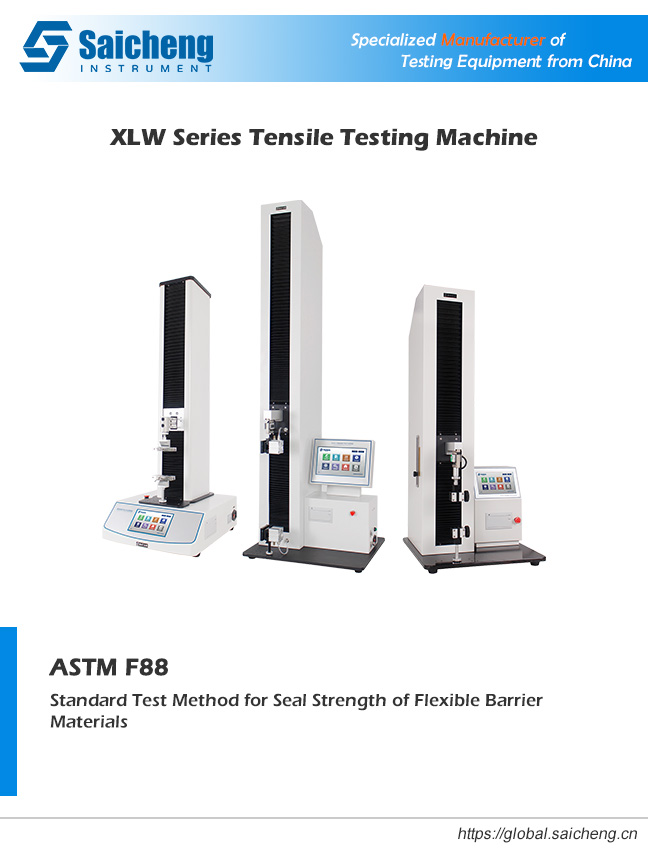
Intelligent Tensile Testing Machine XLW-L
XLW-L Intelligent Tensile Testing Machine specializes in testing the mechanical properties of various flexible packaging materials.

Universal Tensile Testing Machine XLW-H
XLW-H Universal Tensile Testing Machine measures mechanical properties (tensile strength, peel, elongation rate, etc) of various flexible packaging materials.
We hope this helps and as always, we aim to ensure we can help and be proactive.
You can contact your Saicheng sales representative by email. Alternatively, complete the contact us form and we will get back to you as soon as possible.
About ASTM Standards
Learn more about the ASTM F88 Test Standards.
Customized Testing Solutions
Meet ASTM F88 for Your Need

About Saicheng Instrument
Saicheng Instrument Company is a technology-based enterprise dedicated to the development, production and sales of physical property testing instruments. Since its establishment in 2007, the company has provided high-quality testing instruments and comprehensive quality control solutions for packaging, food, pharmaceutical, medical equipment, adhesive products, quality inspection institutions, scientific research institutions, daily chemical industries and other industries.
-
![Saicheng - Office Building]()
Office Building -
![Saicheng - Office Wall]()
Office Wall -
![Saicheng - Laboratory]()
Laboratory -
![Saicheng - Manufacturing Workshop]()
Manufacturing Workshop -
![Saicheng - Manufacturing Workshop]()
Manufacturing Workshop -
![Saicheng - Warehouse]()
Warehouse -
![Saicheng - Visit Us at Exhibition]()
Visit Us at Exhibition -
![Saicheng - Visit Us at Exhibition]()
Visit Us at Exhibition


Why Choose Saicheng Instrument?
Jinan Saicheng Instrument adheres to independent research and development, continuous innovation, and focuses on R&D investment. The company is equipped with a high-quality, high-level R&D team. It holds complete independent intellectual property rights and is currently leading or participating in the drafting of national standards. The company has over 50 patents, including invention patents, utility model patents, and software copyrights. It has passed the evaluation for high-tech enterprises, provincial specialties, and new enterprises. Additionally, the company has obtained software enterprise and software product certifications, as well as ISO 9001 quality management system certification.
-
![Saicheng - High-tech Enterprise Certification]() High-tech Enterprise Certification
High-tech Enterprise Certification -
![Saicheng - Specialized and New Enterprise]() Specialized and New Enterprise
Specialized and New Enterprise -
![Saicheng - Innovative SMEs]() Innovative SMEs
Innovative SMEs -
![Saicheng - Double-soft Enterprise Certification]() Double-soft Enterprise Certification
Double-soft Enterprise Certification


-
![Saicheng - ISO9001:2015]() ISO9001:2015
ISO9001:2015 -
![Saicheng - CE Certificate]() CE Certificate
CE Certificate -
![Saicheng - Patents]() Patents
Patents -
![Saicheng - Computer Software Copyright Certificate]() Computer Software Copyright Certificate
Computer Software Copyright Certificate


What warranty and support can you expect?
Our sales, engineering, and technical support teams are dedicated to delivering the highest level of customer service.
![Strict Quality Control System]()
Strict Quality Control System
Ensuring the highest standards in every product
Our factory has a strict quality control system. Each shipment of our orders undergoes five inspection steps: materials checking, production process monitoring, finished product testing, equipment packing, and loading. When any problems arise, it's easier to resolve the issues quickly.
![Routine Test]()
Perfect Packing and Shipping
Ensuring safe and secure delivery of our products
The shipping department will prepare a checklist and pack the items in a wooden box. You will receive a checklist with everything we shipped. After shipping, we will provide completed loading pictures and a checklist with images of all parts.
![Routine Test]()
High-Efficiency After-Sales Service
Ensuring prompt & effective support for our customers
We have a standardized and comprehensive after-sales service process. Our primary goal is to ensure quality in advance to minimize after-sales issues. If any problems arise, we address them with the highest efficiency, whether by sending replacements or covering repair costs.