


ASTM E96
Standard Test Methods for Gravimetric Determination of Water Vapor Transmission Rate of Materials
These test methods cover the determination of water vapor transmission rate (WVTR) of materials, such as, but not limited to, paper, plastic films, other sheet materials, coatings, foams, fiberboards, gypsum and plaster products, wood products, and plastics. Two basic methods, the Desiccant Method and the Water Method, are provided for the measurement of WVTR. In these tests, the desired temperature and side-to-side humidity conditions, with resultant vapor drive through the specimen, are used. The test conditions employed are at the discretion of the user, but in all cases, are reported with the results.
What is ASTM E96?
ASTM E96, formally known as "ASTM E96/E96M-22, Standard Test Methods for Water Vapor Transmission of Materials," is a widely used standard to measure water vapor transmission rate (WVTR) through various materials, including plastic films, coatings, and textiles. This standard is essential in industries such as packaging, construction, and textiles, where understanding how much moisture passes through materials impacts product quality, durability, and performance. ASTM E96 provides two primary methods, referred to as the "Desiccant Method" and the "Water Method," to evaluate water vapor permeability. The standard is vital for ensuring that products maintain proper moisture levels for optimal functionality and shelf life.
What is the Difference Between ASTM E96 Method A and B?
ASTM E96 offers two main approaches for measuring water vapor transmission—Method A (Desiccant Method) and Method B (Water Method). In Method A, the testing chamber contains a desiccant, which absorbs moisture, creating a low-humidity environment beneath the test specimen. The moisture vapor from the external environment then permeates through the material into the chamber, allowing the WVTR to be measured. In contrast, Method B utilizes a water reservoir within the chamber to create a high-humidity environment on one side of the material. The water vapor then passes through the specimen to the lower-humidity side, enabling measurement of the transmission rate. Generally, Method A is preferred for materials with lower moisture permeability, while Method B is often used for more permeable materials.
What is the Difference Between ASTM E96 and ASTM F1249?
ASTM E96 and ASTM F1249 are both standards for assessing the water vapor transmission rate of materials, yet they differ in methodology and applications. ASTM E96 is a gravimetric method, relying on weight change measurements over time to assess water vapor movement through materials. ASTM F1249, however, uses a manometric (sensor-based) technique to measure transmission, offering a more automated approach with real-time results and increased sensitivity for low-permeability films. ASTM F1249 is often preferred in the packaging industry, particularly for materials with very low WVTR, as it can detect minute changes quickly and accurately. ASTM E96, though less sensitive, is more versatile and can handle a broader range of materials and conditions.
What is Breathability ASTM E96?
In ASTM E96, "breathability" refers to the ability of a material to allow water vapor to pass through, an essential property in applications like protective clothing, packaging, and construction. Breathable materials help regulate moisture by permitting the transmission of water vapor while blocking liquids, essential for comfort and preventing mold or degradation in products. The breathability of a material under ASTM E96 is determined by its WVTR, with higher rates indicating higher breathability. This property is particularly crucial in industries like healthcare and outdoor apparel, where moisture management affects user comfort and product functionality.
What is ASTM E96 Cup Method?
The ASTM E96 "Cup Method" is a commonly used approach within the standard to evaluate water vapor transmission. In this method, the test specimen is placed over a test cup filled with either a desiccant (Method A) or water (Method B). The assembly is then sealed, and the entire setup is weighed over time as moisture either accumulates in or escapes from the cup. The change in weight allows for the calculation of the WVTR. The Cup Method is favored for its straightforward setup and adaptability across different materials, from building membranes to packaging films, making it a practical choice in quality control and material testing.
ASTM E96 is a widely accepted test standard for measuring the water vapor transmission rate (WVTR) of sheet materials
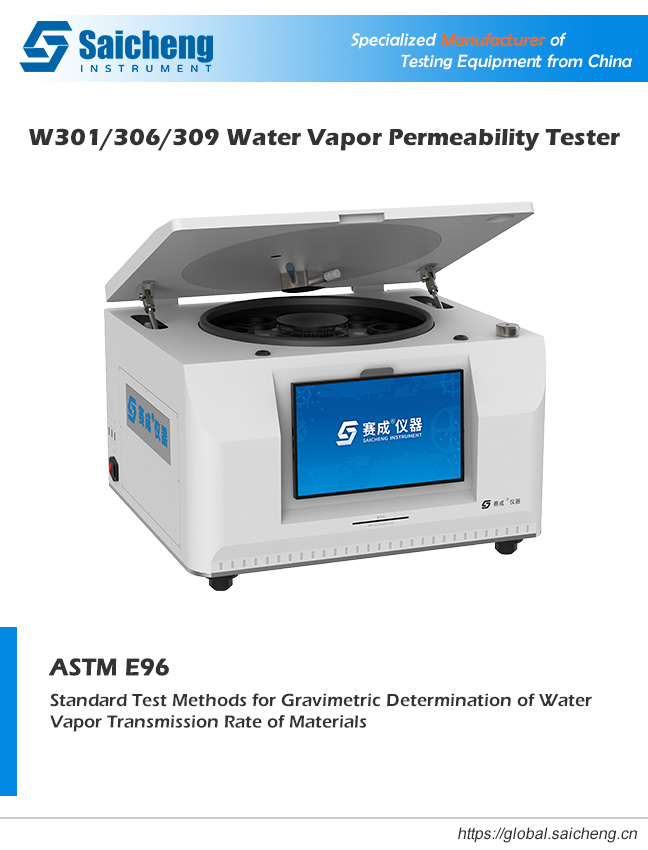
Saicheng Instrument provides W series water vapor transmission rate testers for materials, conforming to ASTM E96 (Gravimetric Method) test standards.

Water Vapor Permeability Tester W301
W301 Water Vapor Permeability Tester is based on the gravimetric method and can be used to test the WVTR of sheet materials and containers.

Water Vapor Permeability Tester W306
W306 Gravimetric Method Water Vapor Permeability Tester can be used to test the WVTR of plastic films, papers, sheets, containers and other materials.

Water Vapor Permeability Tester W309
W309 Water Vapor Permeability Tester is based on the gravimetric (cup) method and can be used to test the WVTR of plastic films, sheets, and other materials.
We hope this helps and as always, we aim to ensure we can help and be proactive.
You can contact your Saicheng sales representative by email. Alternatively, complete the contact us form and we will get back to you as soon as possible.
About ASTM Standards
Learn more about the ASTM E96 Test Standards.
Customized Testing Solutions
Meet ASTM E96 for Your Need

About Saicheng Instrument
Saicheng Instrument Company is a technology-based enterprise dedicated to the development, production and sales of physical property testing instruments. Since its establishment in 2007, the company has provided high-quality testing instruments and comprehensive quality control solutions for packaging, food, pharmaceutical, medical equipment, adhesive products, quality inspection institutions, scientific research institutions, daily chemical industries and other industries.
-
![Saicheng - Office Building]()
Office Building -
![Saicheng - Office Wall]()
Office Wall -
![Saicheng - Laboratory]()
Laboratory -
![Saicheng - Manufacturing Workshop]()
Manufacturing Workshop -
![Saicheng - Manufacturing Workshop]()
Manufacturing Workshop -
![Saicheng - Warehouse]()
Warehouse -
![Saicheng - Visit Us at Exhibition]()
Visit Us at Exhibition -
![Saicheng - Visit Us at Exhibition]()
Visit Us at Exhibition


Why Choose Saicheng Instrument?
Jinan Saicheng Instrument adheres to independent research and development, continuous innovation, and focuses on R&D investment. The company is equipped with a high-quality, high-level R&D team. It holds complete independent intellectual property rights and is currently leading or participating in the drafting of national standards. The company has over 50 patents, including invention patents, utility model patents, and software copyrights. It has passed the evaluation for high-tech enterprises, provincial specialties, and new enterprises. Additionally, the company has obtained software enterprise and software product certifications, as well as ISO 9001 quality management system certification.
-
![Saicheng - High-tech Enterprise Certification]() High-tech Enterprise Certification
High-tech Enterprise Certification -
![Saicheng - Specialized and New Enterprise]() Specialized and New Enterprise
Specialized and New Enterprise -
![Saicheng - Innovative SMEs]() Innovative SMEs
Innovative SMEs -
![Saicheng - Double-soft Enterprise Certification]() Double-soft Enterprise Certification
Double-soft Enterprise Certification


-
![Saicheng - ISO9001:2015]() ISO9001:2015
ISO9001:2015 -
![Saicheng - CE Certificate]() CE Certificate
CE Certificate -
![Saicheng - Patents]() Patents
Patents -
![Saicheng - Computer Software Copyright Certificate]() Computer Software Copyright Certificate
Computer Software Copyright Certificate


What warranty and support can you expect?
Our sales, engineering, and technical support teams are dedicated to delivering the highest level of customer service.
![Strict Quality Control System]()
Strict Quality Control System
Ensuring the highest standards in every product
Our factory has a strict quality control system. Each shipment of our orders undergoes five inspection steps: materials checking, production process monitoring, finished product testing, equipment packing, and loading. When any problems arise, it's easier to resolve the issues quickly.
![Routine Test]()
Perfect Packing and Shipping
Ensuring safe and secure delivery of our products
The shipping department will prepare a checklist and pack the items in a wooden box. You will receive a checklist with everything we shipped. After shipping, we will provide completed loading pictures and a checklist with images of all parts.
![Routine Test]()
High-Efficiency After-Sales Service
Ensuring prompt & effective support for our customers
We have a standardized and comprehensive after-sales service process. Our primary goal is to ensure quality in advance to minimize after-sales issues. If any problems arise, we address them with the highest efficiency, whether by sending replacements or covering repair costs.