


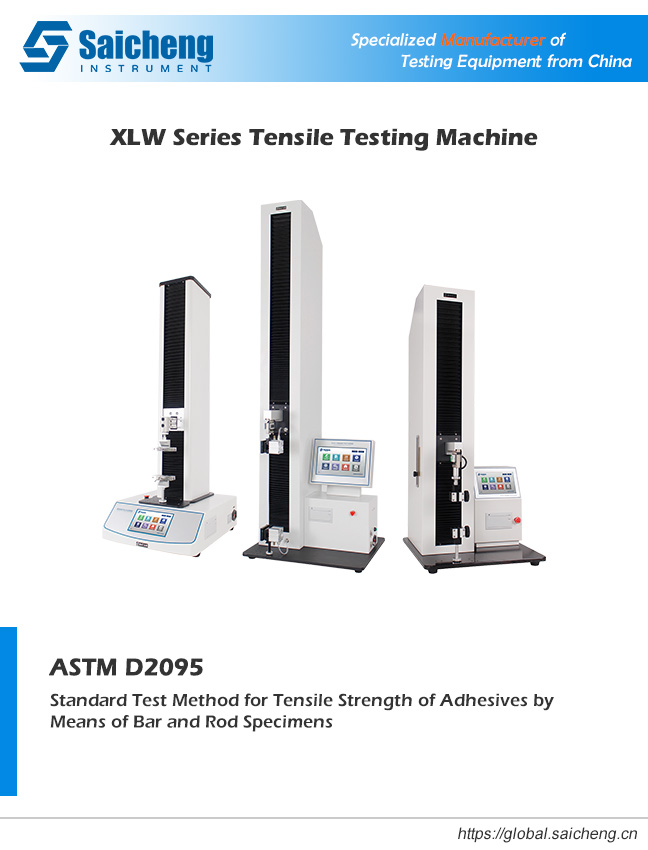
ASTM D2095
Standard Test Method for Tensile Strength of Adhesives by Means of Bar and Rod Specimens
Tension tests provide reasonably accurate information with regard to the tensile strength of adhesives. Tensile strength data may be suitable for specification acceptance, service evaluation, manufacturing control, research, and development. Tension tests are not considered significant for applications differing from the test in rate, direction, and type of loading.
What is ASTM D2095?
ASTM D2095 is a widely recognized standard that outlines the method for testing the tensile strength of adhesives using cylindrical specimens. This test standard is designed to determine the cohesive strength of adhesives by applying tensile loads to adhesive joints made of standard cylindrical samples. By testing these cylindrical adhesive bonds, the standard ensures consistent results across different materials and applications. ASTM D2095 is commonly applied in industries such as aerospace, automotive, and construction, where the performance of adhesive bonds under tensile stress is critical to product reliability.
Test Standard for Determination of Tensile Strength
The determination of tensile strength using ASTM D2095 focuses on measuring the maximum force that an adhesive bond can withstand before failure when subjected to a uniaxial tensile load. Tensile strength is an essential parameter for evaluating the mechanical performance of adhesives, as it reflects the adhesive's ability to resist breaking under tension. In this context, ASTM D2095 serves as a benchmark to ensure that adhesive bonds meet the mechanical requirements needed for their intended applications.
The standard involves bonding two cylindrical substrates using the adhesive under test, creating a lap joint. The tensile force is then applied along the axis of the bond until failure occurs, allowing the evaluation of the bond's tensile strength. The results can be used to compare the performance of different adhesives, evaluate the effects of environmental conditions, or assess the performance of an adhesive after long-term exposure.
ASTM D2095 Test Process
The test process outlined in ASTM D2095 involves several key steps:
- Preparation of Test Specimens: Two cylindrical substrates, often made of metal, plastic, or other materials, are bonded together using the adhesive being tested. The bond line must be uniform, and the adhesive should be applied according to the manufacturer’s instructions to ensure consistent test results.
- Curing of Adhesive: After bonding, the adhesive must be allowed to cure fully. This may involve time, temperature, and environmental conditions, depending on the specific adhesive being tested.
- Mounting of the Specimen: Once cured, the bonded specimen is mounted into a tensile testing machine. The grips of the machine are aligned along the axis of the cylindrical joint to ensure that the tensile load is applied uniformly across the bond line.
- Application of Tensile Load: A tensile force is applied gradually along the axis of the adhesive bond. The force is increased at a constant rate until the bond fails. Throughout the process, the applied load is monitored to determine the maximum tensile strength at failure.
- Data Analysis: After the adhesive bond fails, the tensile strength is calculated by dividing the maximum load at failure by the cross-sectional area of the adhesive bond. This value represents the adhesive's tensile strength, which can be used for material comparisons and quality control.
By following ASTM D2095, manufacturers and researchers can evaluate adhesive performance in a standardized, repeatable manner, ensuring the reliability of tensile strength data for adhesives used in demanding applications.

Medical Packaging Tester MED-02
MED-02 Medical Packaging Tester is professionally applicable to the determination of force properties of various pharmaceutical packaging materials.

Intelligent Tensile Testing Machine XLW-L
XLW-L Intelligent Tensile Testing Machine specializes in testing the mechanical properties of various flexible packaging materials.

Universal Tensile Testing Machine XLW-H
XLW-H Universal Tensile Testing Machine measures mechanical properties (tensile strength, peel, elongation rate, etc) of various flexible packaging materials.
We hope this helps and as always, we aim to ensure we can help and be proactive.
You can contact your Saicheng sales representative by email. Alternatively, complete the contact us form and we will get back to you as soon as possible.
About ASTM Standards
Learn more about the ASTM D2095 Test Standards.
Customized Testing Solutions
Meet ASTM D2095 for Your Need

About Saicheng Instrument
Saicheng Instrument Company is a technology-based enterprise dedicated to the development, production and sales of physical property testing instruments. Since its establishment in 2007, the company has provided high-quality testing instruments and comprehensive quality control solutions for packaging, food, pharmaceutical, medical equipment, adhesive products, quality inspection institutions, scientific research institutions, daily chemical industries and other industries.
-
![Saicheng - Office Building]()
Office Building -
![Saicheng - Office Wall]()
Office Wall -
![Saicheng - Laboratory]()
Laboratory -
![Saicheng - Manufacturing Workshop]()
Manufacturing Workshop -
![Saicheng - Manufacturing Workshop]()
Manufacturing Workshop -
![Saicheng - Warehouse]()
Warehouse -
![Saicheng - Visit Us at Exhibition]()
Visit Us at Exhibition -
![Saicheng - Visit Us at Exhibition]()
Visit Us at Exhibition


Why Choose Saicheng Instrument?
Jinan Saicheng Instrument adheres to independent research and development, continuous innovation, and focuses on R&D investment. The company is equipped with a high-quality, high-level R&D team. It holds complete independent intellectual property rights and is currently leading or participating in the drafting of national standards. The company has over 50 patents, including invention patents, utility model patents, and software copyrights. It has passed the evaluation for high-tech enterprises, provincial specialties, and new enterprises. Additionally, the company has obtained software enterprise and software product certifications, as well as ISO 9001 quality management system certification.
-
![Saicheng - High-tech Enterprise Certification]() High-tech Enterprise Certification
High-tech Enterprise Certification -
![Saicheng - Specialized and New Enterprise]() Specialized and New Enterprise
Specialized and New Enterprise -
![Saicheng - Innovative SMEs]() Innovative SMEs
Innovative SMEs -
![Saicheng - Double-soft Enterprise Certification]() Double-soft Enterprise Certification
Double-soft Enterprise Certification


-
![Saicheng - ISO9001:2015]() ISO9001:2015
ISO9001:2015 -
![Saicheng - CE Certificate]() CE Certificate
CE Certificate -
![Saicheng - Patents]() Patents
Patents -
![Saicheng - Computer Software Copyright Certificate]() Computer Software Copyright Certificate
Computer Software Copyright Certificate


What warranty and support can you expect?
Our sales, engineering, and technical support teams are dedicated to delivering the highest level of customer service.
![Strict Quality Control System]()
Strict Quality Control System
Ensuring the highest standards in every product
Our factory has a strict quality control system. Each shipment of our orders undergoes five inspection steps: materials checking, production process monitoring, finished product testing, equipment packing, and loading. When any problems arise, it's easier to resolve the issues quickly.
![Routine Test]()
Perfect Packing and Shipping
Ensuring safe and secure delivery of our products
The shipping department will prepare a checklist and pack the items in a wooden box. You will receive a checklist with everything we shipped. After shipping, we will provide completed loading pictures and a checklist with images of all parts.
![Routine Test]()
High-Efficiency After-Sales Service
Ensuring prompt & effective support for our customers
We have a standardized and comprehensive after-sales service process. Our primary goal is to ensure quality in advance to minimize after-sales issues. If any problems arise, we address them with the highest efficiency, whether by sending replacements or covering repair costs.