

 Aug 06, 2025

Oxygen and water vapor are primary factors influencing product shelf-life. Studies demonstrate that controlling the internal gas composition within packaging can significantly extend shelf-life or enhance product quality. This principle drives the rapid development and adoption of high-barrier films. However, it's crucial to recognize that leaks in modified atmosphere packaging (MAP) or controlled atmosphere packaging (CAP) – which typically minimize oxygen – can increase oxygen levels. Furthermore, residual air inevitably remains after the initial gas filling. Consequently, the actual internal gas composition often deviates from the intended mixture.
What impact does this discrepancy have? How can these challenges be addressed? This article explores the critical relationship between headspace gas analysis and packaging quality control, while also providing insights into selecting a suitable headspace gas analyzer.

1. The Purpose of Headspace Gas Analysis
A headspace gas mixture exists within virtually all sealed packaging, including snacks, baked goods, meats, dairy, coffee, juice, carbonated drinks, pills, injections, oral medications, perfumes, and toiletries. Even "vacuum-packed" products merely reduce, rather than completely eliminate, internal gases. Controlling or altering the gas composition from the moment of sealing until the package is opened is extremely difficult. Packaging materials primarily act as barriers to external gas infiltration; they cannot eliminate internal gases like oxygen (except with specific oxygen-scavenging technologies). Residual oxygen or other product-sensitive gases can degrade quality and gradually alter the internal atmosphere over time.
MAP and CAP technologies, utilizing inert gases like carbon dioxide (CO2) and nitrogen (N2), are widely employed to minimize detrimental gases and extend shelf-life. Nevertheless, the gas composition inevitably changes during storage. Therefore, regardless of packaging type, precisely controlling the internal gas mixture is challenging, complicating product quality assessment, shelf-life prediction, and packaging design validation.
Headspace gas analysis – testing the composition of the gas accumulated within the sealed package – provides an effective solution. It has become an essential test for evaluating packaging design integrity and verifying product shelf-life.
2. Key Gases in Headspace Analysis: Oxygen and Carbon Dioxide
Oxygen and carbon dioxide are the primary focus of headspace gas analysis due to their profound impact:
Oxygen (O2): Causes nutritional degradation in foods (e.g., fat oxidation leading to rancidity and off-odors, potentially forming toxic compounds). It also facilitates microbial growth, a major cause of spoilage. Conversely, maintaining O2 below 2% and CO2 above 7% can induce food and microbial dormancy, effectively extending shelf-life. Oxygen also degrades many pharmaceuticals (e.g., iron salts, iodides, nitrites, unsaturated organics) and cosmetics containing unsaturated fats, leading to discoloration, odor, decomposition, toxicity, and rancidity.
Carbon Dioxide (CO2): A vital component in MAP/CAP. Its concentration directly correlates with shelf-life length for many products and critically impacts the taste and quality of carbonated beverages. In pharmaceuticals, CO2 can react with certain drugs (e.g., hydroxides, oxides, calcium-based drugs), forming carbonates and causing deterioration.
3. Critical Factors in Headspace Analyzer Selection
Selecting a practical and reliable headspace gas analyzer requires careful consideration of several factors:
Gas Types Analyzed: While most analyzers measure O2, not all measure CO2. Analyzing only O2 provides a snapshot of current quality but hinders accurate shelf-life prediction. Expanding the range of detectable gases improves shelf-life forecasting accuracy.
Sample Gas Volume Requirement: Packaging is trending smaller, reducing internal gas volumes. Traditional handheld analyzers often require a relatively large sample volume, including purge volume for the probe and hose, making small-pack testing difficult. Desktop analyzers with direct sampling capabilities can mitigate this issue.
System Response Time: All analyzers collect gas by penetrating the package seal. However, penetration can cause micro-leaks around the probe, contaminating the sampled gas with ambient air. Faster system response times minimize this contamination, ensuring more accurate results.
Sensor Life: Analyzer sensors are constantly exposed to test gases and have a finite lifespan dictated by the sensing principle and gas concentrations. Replacement is the only option when sensors degrade. Sensor longevity is a key maintenance and cost consideration.
Portability & Data Management: Testing often occurs beyond the lab (e.g., warehouse, store, transport). Good portability is essential for efficiency. While portable devices lack real-time printing, storing data internally can become cumbersome. Ease of data transfer and management is vital.
4. Advantages of the DK-190 Headspace Gas Analyzer
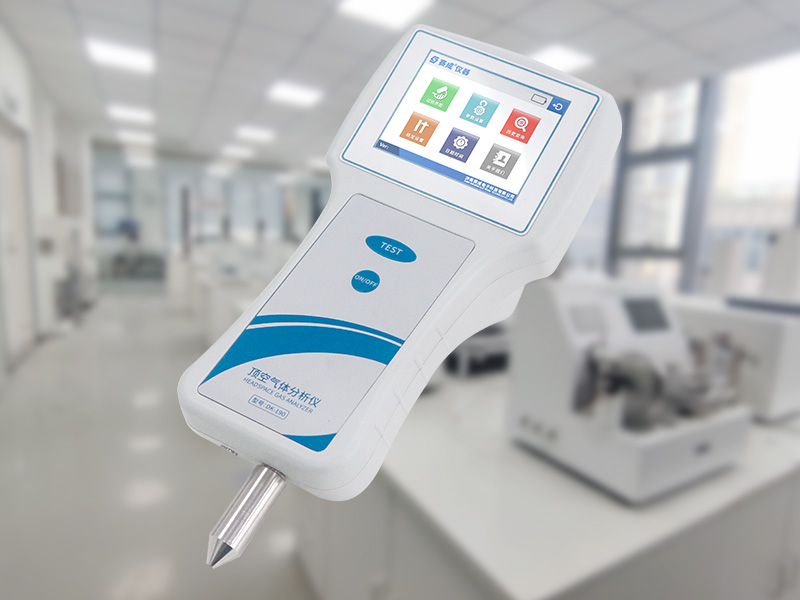
The Saicheng DK-190 Headspace Gas Analyzer combines the strengths of desktop and portable devices with unique features:
Dual Gas Analysis: Accurately measures both O2 and CO2 concentrations, meeting globally recognized standards for precision and range.
Flexible & Precise Sampling: Offers both automatic and exclusive manual sampling modes. Its manual mode achieves an internationally leading low minimum injection volume, enabling reliable analysis of very small packaging.
Optimized Response & Reliability: Utilizes specialized probes, airtight seals, and filters to minimize response time and prevent contamination, guaranteeing valid and reliable data.
Extended Sensor Life: Features sensors with a globally leading lifespan, ensuring a minimum of 6 years of normal operation.
Enhanced Field Usability: While larger than typical portables, it incorporates a printing function absent in most. Housed in a professional, portable toolbox, it facilitates quick analysis in diverse environments.
5. Summary
Headspace gas analysis is indispensable for conveniently, accurately, and rapidly monitoring changes in the internal atmosphere of packaged goods. It provides critical insights into product quality, validates shelf-life estimates, and assesses packaging design effectiveness, making it fundamental to robust quality control. Selecting practical and reliable analysis equipment is paramount for ensuring the accuracy and effectiveness of this vital quality assurance process.