

 Aug 20, 2020

Coefficient of friction, the ratio of the frictional force resisting the motion of two surfaces in contact to the normal force pressing the two surfaces together. It is usually symbolized by the Greek letter mu (μ). Mathematically, μ = F/N, where F is the frictional force and N is the normal force. Because both F and N are measured in units of force (such as newtons or pounds), the coefficient of friction is dimensionless.
The coefficient of friction has different values for static friction and kinetic friction. In static friction, the frictional force resists force that is applied to an object, and the object remains at rest until the force of static friction is overcome. In kinetic friction, the frictional force resists the motion of an object.
Standards for the Coefficient of Friction Test in the Packaging Industry
ISO 8295 and ASTM D1894 are two important standards used to determine the coefficient of friction of plastic films and sheets. While they share similarities, they also exhibit differences in areas such as testing principles, scope of application, testing conditions and operational procedures. When carrying out tests, the appropriate standard must be selected based on the specific characteristics of the material and the testing requirements. To ensure the accuracy and reliability of the test results, operations must be conducted in strict compliance with the standard specifications.
Recommended COF Testing Equipment
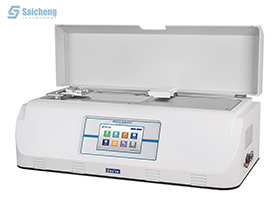
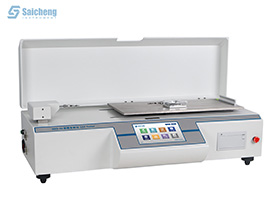
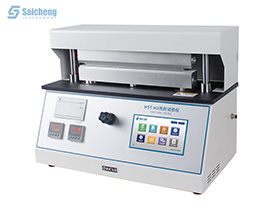
The Saicheng coefficient of friction tester is suitable for testing the friction coefficient of sheet materials such as plastic films, paper, paperboard, coatings and polymers. It can also be used to test the friction coefficient of special materials such as brake pads, flooring, windscreen wipers and medical conduits.